
Fichier:Millisecond Pulsar.jpg

Ce fichier et sa description proviennent de Wikimedia Commons.


Description
| Description |
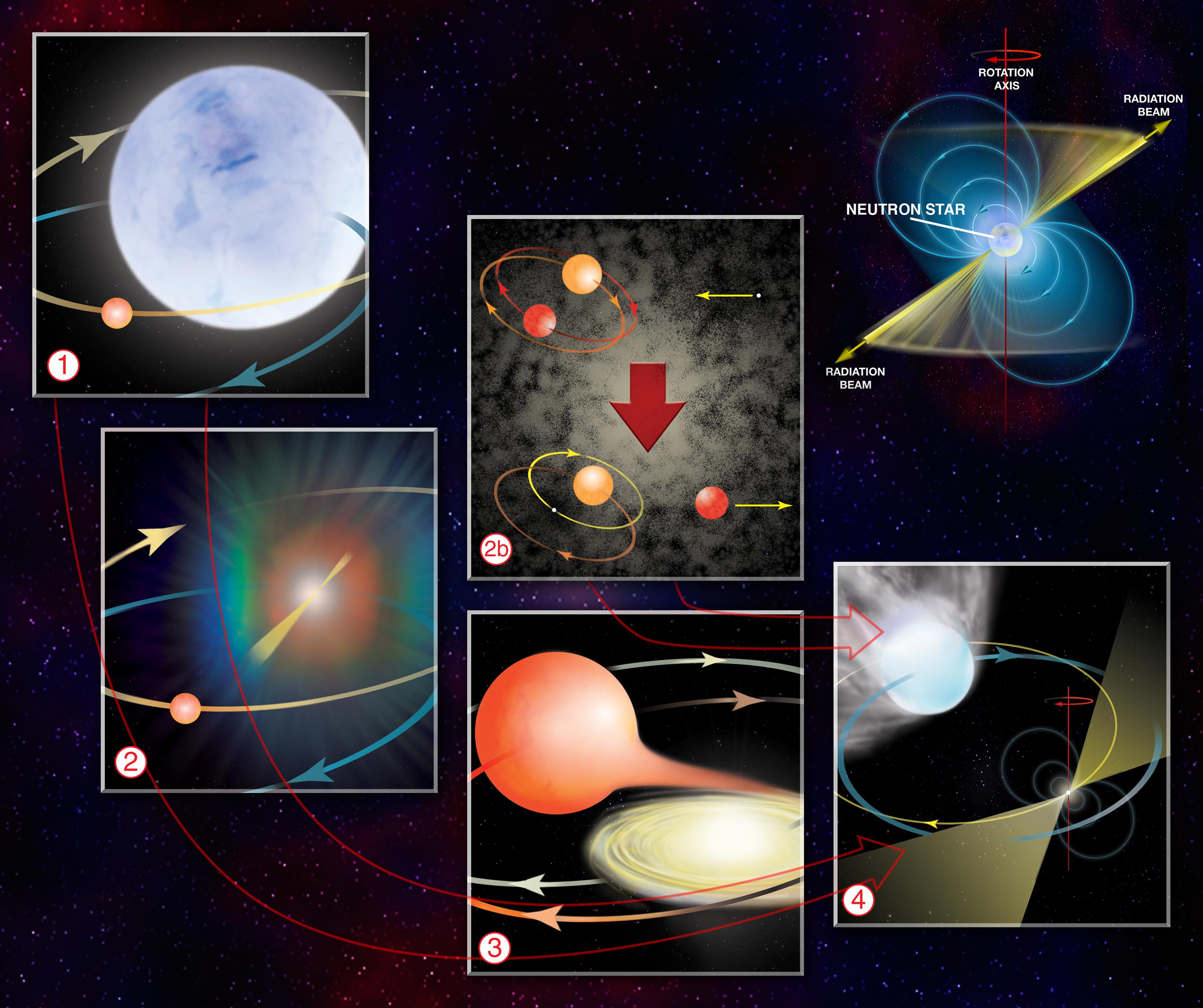
English: The diagram outlines each step needed to create a pulsar with a superfast spin. The Standard Scenario (1-4):
1. A massive supergiant star and a “normal” Sun-like star orbit each other in a binary star system. 2. The massive star exhausts its nuclear fuel and explodes in a supernova, leaving a neutron star as its remnant. For several tens of millions of years, that neutron star is likely active as a radio pulsar. Eventually it slows down, turns off as a pulsar and becomes simply a cooling neutron star. 3. After billions of years, and if the binary survived the supernova, the lower-mass star evolves and expands into a red giant. Material from the star spills into a disk around the neutron star and eventually onto the neutron star surface in a process known as “accretion.” Accretion transfers angular momentum to the neutron star and makes it spin more rapidly. During this process, the system is visible as an X-ray binary. 4. Once accretion ends, the neutron star is spinning very rapidly and emerges as a millisecond radio pulsar. This process is known as “recycling.” Strong “winds” from the pulsar slowly erode away the companion star, which can eclipse the pulsar’s radio emission. But in a globular cluster (2b)… There are so many stars packed so densely together that interactions between ancient “dead” neutron stars and normal stellar binaries can occur (top). When that happens, in a process called “exchange,” the lowest mass star is usually ejected from the binary and the neutron star replaces it (bottom). Once the remaining normal star evolves into a red giant, the rest of the standard “recycling” scenario (3-4) takes place. These interactions and exchanges explain why globular clusters have so many more millisecond pulsars per unit mass than the Galactic disk.Bahasa Indonesia: Diagram ini menguraikan setiap langkah yang diperlukan untuk menciptakan pulsar dengan putaran supercepat. |
| Date | |
| Source | https://public.nrao.edu/gallery/how-to-make-a-millisecond-pulsar (direct link) |
| Auteur ou autrice | B. Saxton, NRAO/AUI/NSF |
Conditions d’utilisation
  |
All images and videos released by NRAO on their website are copyright protected on behalf of the National Radio Astronomy Observatory (NRAO), Associated Universities, Inc. (AUI), and the National Science Foundation (NSF), and are licensed for use under the Creative Commons Attribution 4.0 Unported license (https://creativecommons.org/licenses/by/4.0/) in accordance with the conditions below. See the NRAO Image Use Policy for complete information.
Conditions:
Notes:
|
.jpg) |
- Vous êtes libre :
- de partager – de copier, distribuer et transmettre cette œuvre
- d’adapter – de modifier cette œuvre
- Sous les conditions suivantes :
- paternité – Vous devez donner les informations appropriées concernant l'auteur, fournir un lien vers la licence et indiquer si des modifications ont été faites. Vous pouvez faire cela par tout moyen raisonnable, mais en aucune façon suggérant que l’auteur vous soutient ou approuve l’utilisation que vous en faites.
Historique du fichier
Cliquer sur une date et heure pour voir le fichier tel qu'il était à ce moment-là.
| Date et heure | Vignette | Dimensions | Utilisateur | Commentaire | |
|---|---|---|---|---|---|
| actuel | 13 août 2021 à 20:55 | | 3 000 × 2 513 (632 kio) | Artem.G | Uploaded a work by National Radio Astronomy Observatory (NRAO) from https://public.nrao.edu/gallery/how-to-make-a-millisecond-pulsar/ with UploadWizard |
Utilisation du fichier
La page suivante utilise ce fichier :
Usage global du fichier
Les autres wikis suivants utilisent ce fichier :
- Utilisation sur en.wikipedia.org
- Utilisation sur fa.wikipedia.org
- Utilisation sur mk.wikipedia.org
- Utilisation sur uk.wikipedia.org
- Utilisation sur vi.wikipedia.org
- Utilisation sur www.wikidata.org
