Cet article est une ébauche concernant l’analyse.
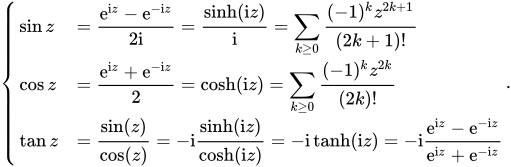
Dans le plan des nombres complexes, grâce aux formules d'Euler, les fonctions trigonométriques satisfont les égalités suivantes : { sin z = e i z − e − i z 2 i = sinh ( i z ) i = ∑ k ≥ 0 ( − 1 ) k z 2 k + 1 ( 2 k + 1 ) ! cos z = e i z + e − i z 2 = cosh ( i z ) = ∑ k ≥ 0 ( − 1 ) k z 2 k ( 2 k ) ! tan z = sin ( z ) cos ( z ) = − i sinh ( i z ) cosh ( i z ) = − i tanh ( i z ) = − i e i z − e − i z e i z + e − i z . {\displaystyle {\begin{cases}\sin z&=\displaystyle {\frac {\mathrm {e} ^{\mathrm {i} z}-\mathrm {e} ^{-\mathrm {i} z}}{2\mathrm {i} }}={\frac {\sinh(\mathrm {i} z)}{\mathrm {i} }}=\sum _{k\geq 0}{\frac {(-1)^{k}z^{2k+1}}{\left(2k+1\right)!}}\\\cos z&=\displaystyle {\frac {\mathrm {e} ^{\mathrm {i} z}+\mathrm {e} ^{-\mathrm {i} z}}{2}}=\cosh(\mathrm {i} z)=\sum _{k\geq 0}{\frac {(-1)^{k}z^{2k}}{\left(2k\right)!}}\\\tan z&=\displaystyle {\frac {\sin(z)}{\cos(z)}}=-\mathrm {i} {\frac {\sinh(\mathrm {i} z)}{\cosh(\mathrm {i} z)}}=-\mathrm {i} \tanh(\mathrm {i} z)=-\mathrm {i} {\frac {\mathrm {e} ^{\mathrm {i} z}-\mathrm {e} ^{-\mathrm {i} z}}{\mathrm {e} ^{\mathrm {i} z}+\mathrm {e} ^{-\mathrm {i} z}}}\end{cases}}.} De même que leurs fonctions réciproques arcsin z = − i ln ( i z + 1 − z 2 ) {\displaystyle \arcsin z=-\mathrm {i} \ln \left(\mathrm {i} z+{\sqrt {1-z^{2}}}\right)} , arccos z = − i ln ( z + z 2 − 1 ) {\displaystyle \arccos z=-\mathrm {i} \ln \left(z+{\sqrt {z^{2}-1}}\right)} et arctan z = i 2 [ ln ( 1 − i z ) − ln ( 1 + i z ) ] {\displaystyle \arctan z={\frac {\mathrm {i} }{2}}\left[\ln \left(1-\mathrm {i} z\right)-\ln(1+\mathrm {i} z)\right]} . Ces fonctions réciproques souffrent des mêmes problèmes d'indétermination que le logarithme complexe.
Rappel : e a + i b = e a e i b = e a ( cos ( b ) + i sin ( b ) ) {\displaystyle \mathrm {e} ^{a+\mathrm {i} b}=\mathrm {e} ^{a}\mathrm {e} ^{\mathrm {i} b}=\mathrm {e} ^{a}\left(\cos(b)+\mathrm {i} \sin(b)\right)} .
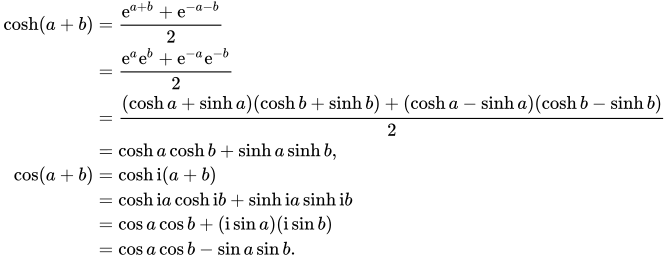
Pour tous nombres complexes a et b, on a par exemple cosh ( a + b ) = cosh a cosh b + sinh a sinh b cos ( a + b ) = cos a cos b − sin a sin b . {\displaystyle {\begin{aligned}\cosh(a+b)&=\cosh a\cosh b+\sinh a\sinh b\\\cos(a+b)&=\cos a\cos b-\sin a\sin b\end{aligned}}.}
d'où (en remplaçant b par ib) :
Pour les autres fonctions trigonométriques, on fait de même. Pour tan, cot, tanh et coth, Il vaut mieux utiliser leurs définitions, soit tan z = sin z cos z , cot z = cos z sin z , tanh z = sinh z cosh z , coth z = cosh z sinh z . {\displaystyle \tan z={\frac {\sin z}{\cos z}},\quad \cot z={\frac {\cos z}{\sin z}},\quad \tanh z={\frac {\sinh z}{\cosh z}},\quad \coth z={\frac {\cosh z}{\sinh z}}.}







![{\displaystyle \arctan z={\frac {\mathrm {i} }{2}}\left[\ln \left(1-\mathrm {i} z\right)-\ln(1+\mathrm {i} z)\right]}](https://wikimedia.org/api/rest_v1/media/math/render/svg/4d0761e030769776419f62c8411dccba7a95f7a4)

