
Utilisateur:Alexandre Vendryes/Brouillon5
The electromagnetic mass of a system refers to the contribution of electromagnetic interactions to its inertia. It is a classical concept first introduced in 1881 by Joseph J. Thomson[1][2]. Electromagnetic mass, like inductance or the Abraham–Lorentz force, is a self-interaction phenomenon, in the sense that a charged body interacts with its own electromagnetic field. It is expressed in kilograms (kg) in the International System of Units (SI).
Physical cause
modifierOriginally, it was thought that the mass of a body (i.e. its resistance to acceleration) was solely related to the amount of matter it contained. However, the laws of classical electromagnetism show that two bodies containing the same amount of matter can nonetheless have different masses.
Derivation
modifierTo illustrate this, consider a system consisting of two point electric charges q1 and q2 separated by a distance r.

When this system is at rest, the mutual electric forces between the two charges are equal and opposite (Coulomb's law), which means that the net force is zero.
If the entire system is now given an acceleration directed to the right (keeping the distance r between the two charges constant), this is no longer the case[3]: since the electric field produced by each charge does not propagate instantaneously but at the speed of light (c = 299,792,458 m/s), the force experienced by each charge no longer depends on the current position of the other charge, but on its retarded position (t' = t − r/c). As a result, the force exerted by q2 on q1 becomes slightly stronger than the force exerted by q1 on q2. This imbalance leads to the appearance of a net force Fself acting on the whole system. This force is directed to the left and therefore tends to oppose the acceleration[4].


To calculate Fself, we need to compute the electric force exerted by each charge on the other, taking into account retardation effects in the propagation of the electric field. To do so, we can use the relation F = q E and compute the electric field E created by each charge using the Darwin model, which approximates field expressions to order 1/c² in the quasi-static approximation[5]. The general expression for the field E is:
|
|

where all quantities are instantaneous (i.e. evaluated at the present time t). The first term represents the Coulomb field, and the second is a corrective term, caused by the acceleration of the charges, which precisely accounts for retardation effects.
As mentioned above, the first term (though much larger in magnitude than the second) yields equal and opposite forces. The acceleration-dependent term, however, can produce forces that are not equal and opposite. Computing the net self-force Fself acting on the system gives[3]:

The resulting force is proportional to and increases the system's resistance to acceleration. It can therefore be considered (by definition) as increasing the mass of the system, with the mass increment Δm given (using Newton's second law) by[3]:
|
|

Calling this mass increment the "interaction electromagnetic mass" of the two charges, one obtains[3]:

Note that if the charges q1 and q2 have the same sign, the electromagnetic mass is positive (referred to as a mass excess), whereas if the charges have opposite signs, the electromagnetic mass is negative (referred to as a mass defect).
Denoting by m1 the mass of charge q1, m2 the mass of charge q2, and Mtot the total mass of the system {q1+q2}, one finally has:

Conclusion: The laws of classical electromagnetism show that long-range interactions between charged particles can affect the overall mass of a system, which implies that the inertia of a body does not depend solely on the amount of matter it contains. The appearance of an interaction mass is caused by the finite speed at which fields propagate through space (c). Thus, a charged capacitor will be slightly more massive than the same uncharged capacitor, even though both consist of the exact same number of particles and no matter has been exchanged with the outside.
Transverse orientation
modifier
Considering now the situation in which the acceleration of the two-charge system is orthogonal to the charge axis (θ = 90°), the self-interaction force is[3][6]:

which implies:

The interaction mass obtained is half that found in the longitudinal case[3].

To qualitatively understand the emergence of this self-interaction force in the transverse configuration, one can work in the accelerated frame of the two charges, where the electrostatic field lines appear curved[7], much like the trajectory of a tennis ball in a gravitational field. Each charge will then experience a slight electric force component opposing the acceleration, with Ex ~ Ey·(ar/c²) (following the equivalence principle of general relativity, electrostatic field lines are similarly curved for a charge at rest in a gravitational field[7][8]). If the charges have opposite signs, the self-interaction force is directed along .
Arbitrary orientation
modifierIf the charge axis makes an arbitrary angle θ with the acceleration vector , the interaction electromagnetic mass of the two charges is[3]:

where the factor (1 + cos² θ) ranges between 1 and 2.
Appearance of a force orthogonal to the acceleration
modifier
When θ is neither 0° nor 90°, a self-interaction force perpendicular to the acceleration () also appears, in addition to the component along the acceleration[3]:


However, only can be considered as contributing to the inertia of the system. For reference:


is maximized when θ = 45°, as can be seen from the trigonometric identity:

since sin(2θ) is maximized at θ = 45°.
Examples
modifierMass defect of the hydrogen atom
modifier
A hydrogen atom consists of two particles with opposite electric charges (a proton and an electron) in interaction.
The respective masses of an isolated proton and electron are:


Their sum is:

The experimentally measured mass of a hydrogen atom is:

One finds:

The difference between the two masses (the mass defect) is:

This mass defect is precisely the (negative) interaction electromagnetic mass between the proton and the electron. It is approximately 100 million times smaller than the total mass of the hydrogen atom.
Electromagnetic mass of a charged sphere
modifier
Consider a sphere of radius R.
Uniformly volume-charged sphere
modifierIf the sphere carries a uniform volume charge density ρ throughout its volume, its electromagnetic mass can be calculated by integrating the mutual interaction forces between all infinitesimal charge pairs. The electromagnetic mass of such a charged sphere is:

This result can also be expressed in terms of the total charge Q carried by the sphere:

Uniformly surface-charged sphere
modifier

Relation between electromagnetic mass and field momentum
modifierBesides the relation m = F/a, there is a second method for computing the electromagnetic mass of a system[3]: it consists of computing the momentum of the electromagnetic field for an arbitrary velocity , then using m = p/v. The electromagnetic field momentum is given by[9]:


|
|

For two interacting bodies 1 and 2:
and
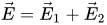
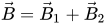
which gives:

Among the four terms, the first two correspond to the individual electromagnetic masses of bodies 1 and 2. To compute only the interaction electromagnetic mass between 1 and 2, only the last two terms need to be considered[3].
This method yields exactly the same results as the m = F/a method in all situations[3] (both methods follow from Maxwell's equations and the Lorentz force).
At the end of the 19th century, some physicists went so far as to claim that "mechanical" mass did not exist, and that 100% of the mass of bodies was of electromagnetic origin[10]. However, such a hypothesis requires treating the electron and other elementary particles as spherical charge distributions, which cannot be assumed without detailed knowledge of the internal structure of these particles[10]. Moreover, it is now known that other interactions in nature, such as gravitation and the strong nuclear interaction, can also affect the mass of bodies (nuclear mass defects are a clear illustration of this).
Relation to electrostatic potential energy and E=mc²
modifierThe electrostatic interaction potential energy of two point charges q1 and q2 is given by:
|
|

From the earlier results for the interaction electromagnetic mass, it follows that for a system of two charges aligned along an axis parallel to the acceleration vector (θ = 0°):

If the charge axis is orthogonal to the acceleration vector (θ = 90°):

The transverse case is therefore consistent with Albert Einstein's general relation between mass and energy (E=mc²), while the longitudinal case differs from this formula by a factor of 2[3].
The 4/3 problem
modifierFor a spherical charge distribution (whether the charge is distributed on the surface of the sphere or throughout its volume), one always finds[10]:

This discrepancy between the results of the two approaches (E=mc² and electromagnetic theory) has generated much debate since the early 20th century[9][10]. This is known as the 4/3 problem.
Poincaré stresses
modifierOne of the most well-known proposals to resolve this paradox was put forward in 1906 by Henri Poincaré: it rests on the observation that a charged system is fundamentally unstable and would tend to fly apart in the absence of external non-electromagnetic forces to stabilize it[3][10]. Poincaré's idea is that these non-electromagnetic forces, the Poincaré stresses, correct the mass discrepancy between the predictions of electromagnetism and those of E=mc².
Nuclear fission
modifier
In nuclear fission, a heavy atomic nucleus is split into lighter nuclides. The electrostatic force between the (positively charged) nuclear fragments causes an intense repulsion that releases a large amount of energy. There is then a conversion of electrostatic potential energy into kinetic energy and radiation (in the case of nuclear fusion, it is potential energy associated with the strong force that is released).
The total mass of the reaction products is then lower than the initial total mass. This difference corresponds to the decrease in the electromagnetic mass of the system due to the separation of the charged particles (the protons), which were originally confined within the same nucleus. The same phenomenon of electromagnetic mass loss occurs when energy is released in chemical reactions, but on a far smaller scale.
Origin of electromagnetic induction
modifier
Returning to the expression (to order 1/c²) of the electric field created by a point charge q in the quasi-static approximation:
one can readily identify the term responsible for the electromagnetic mass (term 2). This term, in addition to giving rise to electromagnetic mass, is also the origin of the phenomenon of electromagnetic induction. Indeed, it also explains why a voltage can appear in an electrical circuit when the current varies. This is related to the fact that the acceleration of charges causes retardation effects in the propagation of the electric field, which manifest as this induction term (note also that, unlike the Coulomb term, this term is not conservative). If the electric field propagated instantaneously, electromagnetic induction would not exist, nor would electromagnetic mass.
This explains why an inductor exhibits a form of electromagnetic inertia, opposing changes in electric current. In doing so, an inductance L stores energy in the same way that a mass M stores kinetic energy:


For reference, an inductor is described by the relation:

In 1912, Albert Einstein published an article entitled "Is There an Analogy Between the Gravitational Effect and the Electrodynamic Induction Effect?"[11], extending these ideas to the gravitational interaction.
Notes and references
modifier- ↑ Joseph John Thomson, On the Electric and Magnetic Effects produced by the Motion of Electrified Bodies, Philosophical Magazine. 5. Vol. 11, no. 68. pp. 229–249, 1881
- ↑ Kirk T. McDonald, On the History of the Radiation Reaction, Princeton University (2017), Part 6: J.J. Thomson and Electromagnetic Mass
- 1 2 3 4 5 6 7 8 9 10 11 12 13 14 David J. Griffiths, Russell E. Owen, Mass renormalization in classical electrodynamics, Am. J. Phys. 51, 1120–1126 (1983)
- ↑ [vidéo] « Disponible », sur YouTube, , [vidéo] « Disponible », sur YouTube,
- ↑ Jonas Larsson, Electromagnetics from a quasistatic perspective, Department of Physics, Umeå University, SE-90187 Umeå, Sweden, 2006
- ↑ Timothy H. Boyer, Electrostatic potential energy leading to an inertial mass change for a system of two point charges, Am. J. Phys. 46, 383–385 (1978)
- 1 2 Maria Becker, Adam Caprez, Herman Batelaan, On the Classical Coupling between Gravity and Electromagnetism, Atoms, 2015
- ↑ Timothy H. Boyer, Electrostatic potential energy leading to a gravitational mass change for a system of two point charges, Am. J. Phys. 47 (1979) 129–131
- 1 2 3 David J. Griffiths, Resource Letter EM-1: Electromagnetic Momentum, Am. J. Phys. 80, 7–18 (2012)
- 1 2 3 4 5 The Feynman Lectures on Physics, Volume II, Chap. 28: Electromagnetic Mass
- ↑ Albert Einstein, Gibt es eine Gravitationswirkung, die der elektrodynamischen Induktionswirkung analog ist?, Vierteljahrsschrift für gerichtliche Medizin und öffentliches Sanitätswesen, vol. 44, 1912, pp. 37–40.